Texture-Specific Diagnostics
4 hours estimated · 7 sections
YOU ARE NOT TATTOOING A SCALP.
YOU ARE MIMICKING A SPECIFIC HAIR TYPE.
IF THE DOTS DON'T MATCH THE TEXTURE, THE RESULT LOOKS WRONG.
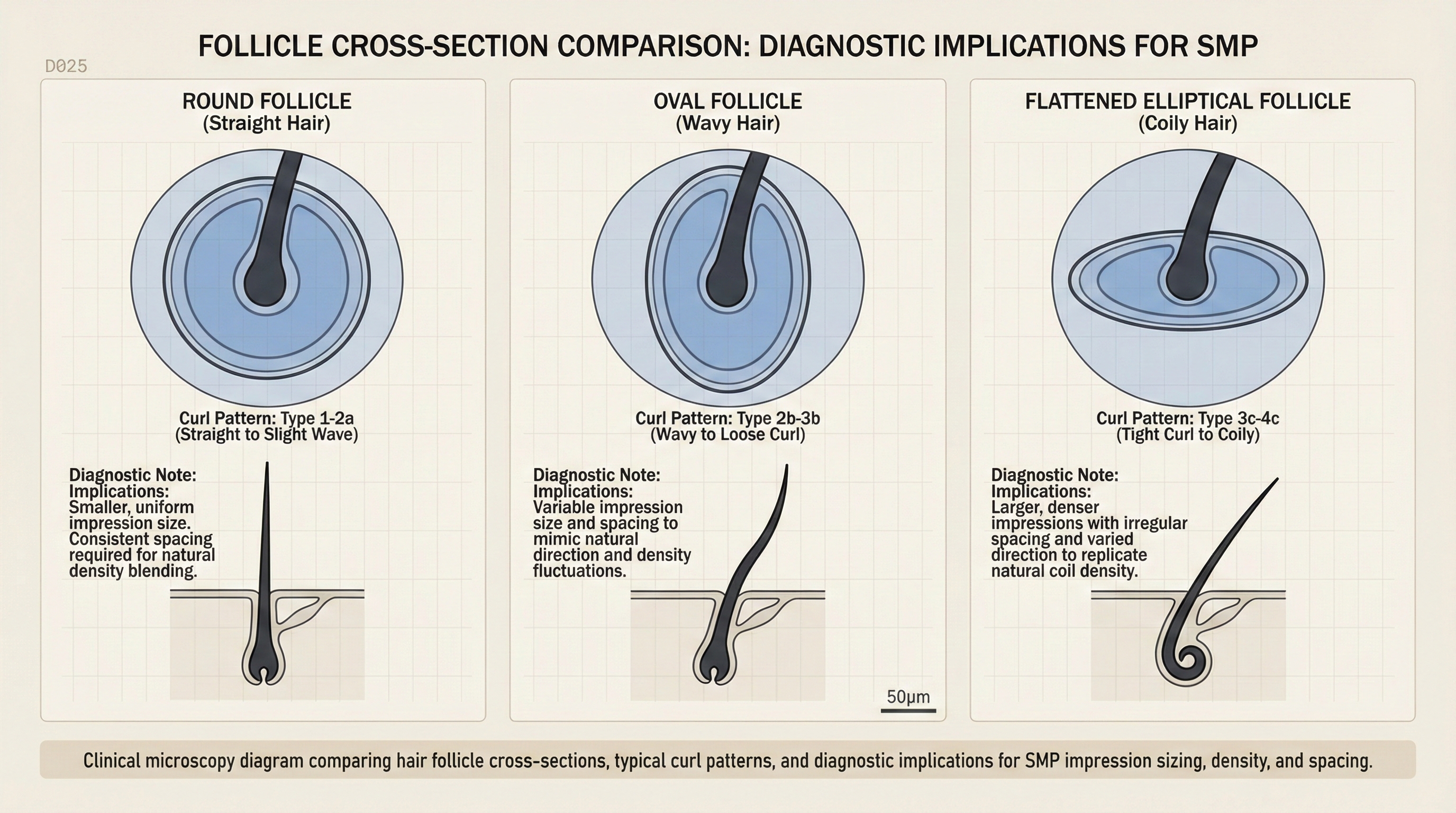
A straight Type 1 hair exits through a round opening. A coily Type 4B exits through a ribbon-shaped opening at a sharp angle. If you place tiny round dots on a 4B scalp, the impressions look like someone else's hair on that person's head.
MODULE OVERVIEW
Modules 1–4 gave you the structural foundation: skull shape, density science, skin behaviour, and hairline anatomy. All of that assumed a generic hair follicle. This module adds the variable that most SMP training skips: the hair itself.
Every SMP impression is a portrait of a specific follicle, and follicles vary by texture. A technician who uses the same needle configuration and dot size across all texture types will produce results that look natural on one type and artificial on every other. This is the most common source of "tattoo-looking" SMP on textured hair, and it is entirely preventable with proper diagnosis.
You are not tattooing a scalp. You are mimicking a specific hair type on a specific scalp. If the dots you place don't match the texture of the hair the client actually grows, the result looks wrong even when the density is perfect.
Why Texture Changes Everything
Here is why texture is a diagnostic variable, not a cosmetic preference. A straight Type 1 hair exits the scalp through a round follicular opening. From above—the only angle SMP replicates—that opening appears as a clean, small, circular dot. A coily Type 4B hair exits through a ribbon-shaped opening at a sharp angle. From above, it appears larger, more elliptical, and slightly irregular.
If you place tiny round dots on a 4B scalp, the impressions will look like someone else's hair on that person's head. The density might be right. The colour might be right. But the texture signature is wrong, and the client's barber will see it immediately.
Every SMP impression is a portrait of a specific follicle, and follicles vary by texture. The cross-sectional shape of a hair follicle determines the geometry of the opening where the hair exits the scalp. That opening is what a close observer sees on a freshly shaved head.
Ready to test your knowledge?
Complete the module quiz to track your progress. You need 80% to pass.
Start Quiz (10 questions)