Assessment Protocols and the KORT Diagnostic File
4 hours estimated · 7 sections
NO NEEDLE BEFORE DIAGNOSIS.
NO DIAGNOSIS WITHOUT DOCUMENTATION.
THE KORT FILE IS THE TREATMENT PLAN.
Modules 1–5 gave you the diagnostic tools. Module 6 integrates them into a single, repeatable assessment workflow. Before any pigment touches skin, the KORT Diagnostic File is complete. Nothing is assumed. Everything is documented.
MODULE OVERVIEW
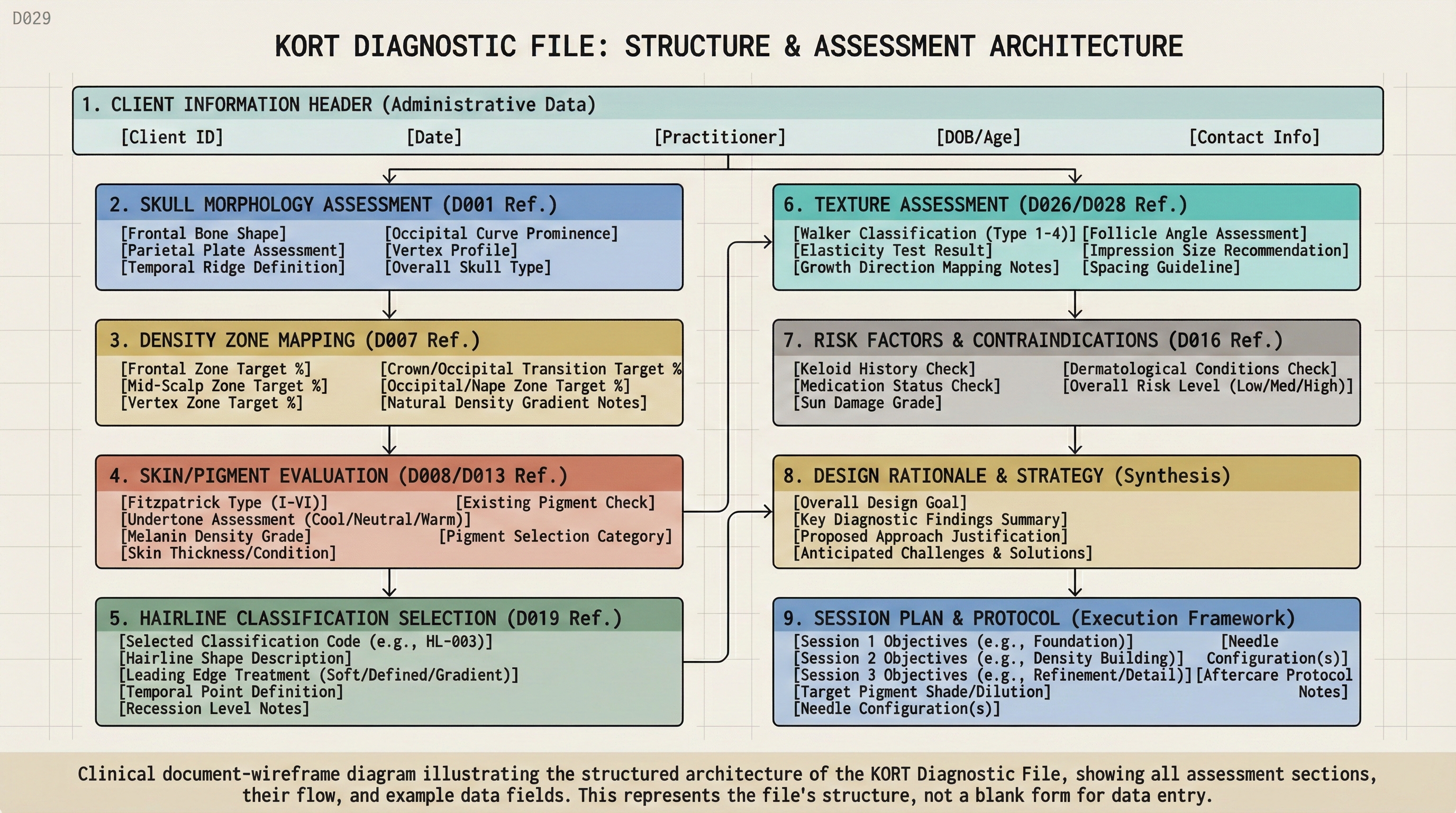
This is the integration module. Everything you have learned in Modules 1–5 converges here into a structured pre-treatment protocol that produces seven diagnostic outputs: skull morphology map, density zone map, skin risk profile, hairline design specification, colour prescription, texture map, and photographic baseline.
Together, these seven outputs form the KORT Diagnostic File — the single document that governs every decision from hairline design through final session review. This module teaches you how to build that file efficiently, consistently, and completely for every client who sits in your chair.
The diagnostic file is not paperwork. It is the treatment plan. Every decision you make during the treatment session should trace back to a documented finding in the file. If you cannot point to the diagnostic basis for a decision, you are improvising—and improvisation produces inconsistent results.
The KORT Diagnostic File
No needle before diagnosis. No diagnosis without documentation. The KORT Diagnostic File is completed before any pigment touches skin—no exceptions.
The KORT Diagnostic File is a structured document that captures seven diagnostic outputs. Each output draws from a specific module in the Foundation Track.
The Seven Diagnostic Outputs
1. Skull morphology map — Cranial regions, parietal ridge position, curvature zones, asymmetries (Module 1).
2. Density zone map — Core, transition, and edge zones with target impressions/cm² per zone (Module 2).
3. Skin risk profile — Fitzpatrick type, KORT extension (undertone, oil, scar history, prior tattoo response), keloid/PIH risk rating (Module 3).
4. Hairline design specification — KORT type (S/G/R/X), placement measurements, midpoint height, temple angle (Module 4).
5. Colour prescription — Pigment selection with Fitzpatrick-matched base, undertone modifier, warm/cool adjustment (Module 3).
6. Texture map — Walker type by zone, impression parameters per zone, traction alopecia staging if applicable (Module 5).
7. Photographic baseline — Standardised seven-view photographic record under consistent lighting.
The diagnostic file protects you and the client. It creates a record of what was assessed, what was agreed, and why specific decisions were made. If a client returns unhappy, the file shows the diagnostic basis for your approach. If a client returns delighted, the file shows what worked so you can replicate it.
Ready to test your knowledge?
Complete the module quiz to track your progress. You need 80% to pass.
Start Quiz (10 questions)