Skull Morphology and SMP Topography
3 hours estimated · 10 sections
THE BARBER READS THE SKULL.
THE TECHNICIAN READS THE SKULL.
KORT TEACHES BOTH TO SPEAK THE SAME LANGUAGE.
Every barber who has ever run a clipper along a temple knows that bone shapes the cut. Every SMP technician who has ever placed an impression along a hairline knows that curvature changes everything. The knowledge is the same knowledge. The vocabulary has never been shared. Until now.
MODULE OVERVIEW
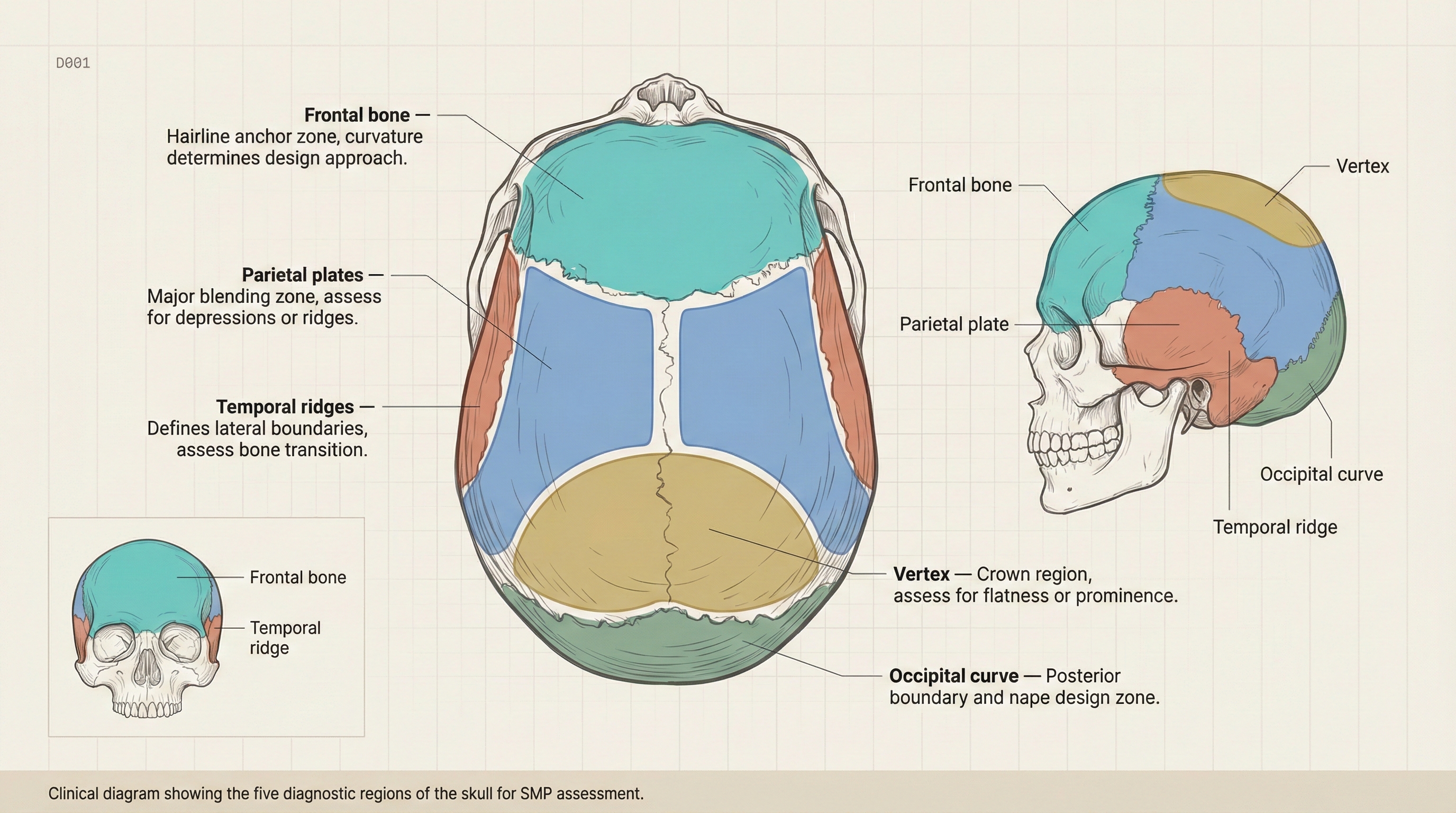
This module teaches you to read the skull as a three-dimensional surface before you touch it with a needle or a clipper. Not as a flat canvas. Not as a template. As a structure with regions, contours, flat zones, and transitions that dictate every decision you will make about hairline placement, density distribution, fade architecture, and impression geometry.
Most SMP training begins with the needle. Most barbering apprenticeships begin with the clipper. Both are wrong for the same reason. They start with the tool instead of the terrain. You would not grade a road without surveying the land. You would not frame a wall without reading the foundation. You should not place a single impression or make a single pass without reading the skull underneath.
The skull is not a sphere. It is an asymmetric, multi-curved surface with flat planes, ridges, depressions, and transition zones that change radically between individuals and between ethnic populations. Every decision — where the hairline sits, how density graduates, where a fade terminates, what impression shape reads as natural — originates from this surface. Read the surface first. Everything else follows.
Why the Skull Comes First
A barber in Peckham picks up a client with a high top fade request. Before the clipper touches skin, the barber is already reading. Where does the parietal ridge sit? High and prominent, or low and gradual? Is the temporal bone flat or does it angle sharply inward? Is there a bump above the occipital — the kind that makes a drop fade look clean on one client and lumpy on another?
The barber does not call these things by their anatomical names. The barber calls the parietal ridge "where the head rounds off." The barber calls the temporal flat "the side panel." The barber calls the occipital protuberance "that bump at the back." But the barber is reading skull morphology with every cut. It is diagnostic reasoning by a different name.
An SMP technician in Atlanta sits down with a client requesting a density fill with a sharp edge-up hairline. Before the machine is switched on, the technician is already reading. How does the forehead curve into the frontal bone? Where does the natural hairline want to sit based on the skull geometry, not where the client points? How will the temple recession interact with the zygomatic arch when viewed at conversation distance?
The technician and the barber are reading the same surface. They are making the same structural assessments. They have never been given a shared language to describe what they see.
SMP training uses clinical terminology borrowed from anatomy and dermatology. Barbering uses shop floor terminology developed over generations of apprenticeship. Both describe the same structures. Neither has learned from the other. KORT bridges this gap by teaching both vocabularies and making explicit the mapping between them. When a barber says "the side panel is flat" and a technician says "the temporal fossa is shallow," they are saying the same thing. When both understand this, collaboration becomes possible.
What Goes Wrong When You Skip the Skull
Consider the most common SMP failures. A hairline that sits too low on the forehead, creating a Lego-man appearance. A density fill that looks patchy under overhead lighting. A fade that reads as a hard line rather than a gradient. A crown treatment that looks flat and artificial despite good impression work. Each of these failures has a common root cause: the practitioner treated the scalp as a two-dimensional surface.
The scalp is not two-dimensional. It is stretched over a complex three-dimensional structure, and that structure determines how light interacts with every impression. A flat zone reflects light differently than a curved zone. A convex surface makes hair appear thinner than the same hair on a concave surface. A transition zone — where the curve changes — is where the eye most easily detects artificial density patterns.
Barbers understand this intuitively. That is why a skilled barber checks the head from multiple angles before beginning a fade. They are reading the terrain. SMP training rarely emphasises this step, and the work suffers as a result.
Ready to test your knowledge?
Complete the module quiz to track your progress. You need 80% to pass.
Start Quiz (10 questions)