Density Science and Follicular Mapping
3 hours estimated · 8 sections
DENSITY IS NOT DOTS PER SQUARE CENTIMETRE.
DENSITY IS PERCEPTION.
KORT TEACHES YOU TO SEE WHAT THE CLIENT WILL SEE.
Two scalps with identical follicle counts can look dramatically different in density because of hair diameter, curl pattern, skin contrast, and surface curvature. The numbers are the starting point. The diagnostic framework is what turns those numbers into results that look like hair instead of pigment.
MODULE OVERVIEW
Module 1 taught you to read the skull. Module 2 teaches you to count what grows on it — and more importantly, to understand why counting alone is not enough.
Density is the most misunderstood variable in SMP. Technicians talk about "adding density" as if density were a single dial you turn up. It is not. Natural scalp density varies by region, by ethnicity, by age, and by hair type. It varies between the left temple and the right temple on the same skull. It varies between morning and afternoon on the same skull under different lighting. And it varies in how it is perceived — two scalps with identical follicle counts per square centimetre can look dramatically different in density because of hair diameter, curl pattern, skin contrast, and surface curvature.
This module gives you the numbers. But it also gives you the framework to interpret those numbers against the skull you mapped in Module 1, so that your density decisions are diagnostic rather than decorative.
Density is not dots per square centimetre. Density is the visual perception of coverage at a given viewing distance, under a given light source, on a given surface curvature, with a given skin-to-impression contrast ratio. The dots-per-cm² figure is the starting input. The diagnostic framework is what turns that input into a result that looks like hair instead of pigment.
Natural Density — The Baseline
Before you place a single impression, you need to know what you are replicating. Not what you think a full head of hair looks like. What a full head of hair actually measures at, region by region, population by population.
Two concepts must be separated immediately, because the SMP industry uses them interchangeably and they are not the same thing.
Follicular Unit Density vs. Hair Density
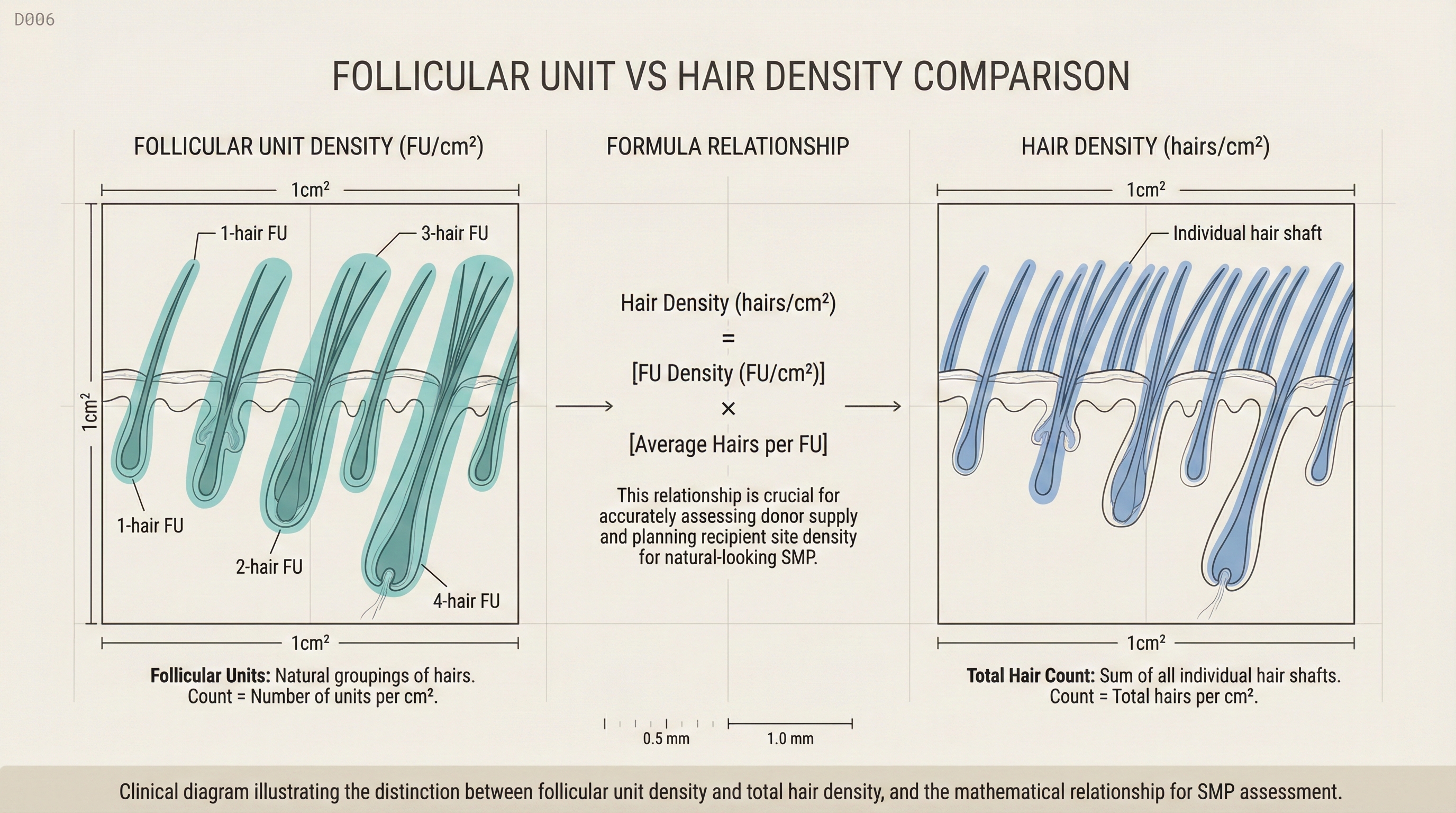
A follicular unit is a natural grouping of hairs that emerge from a single pore. Most follicular units contain between one and four individual hairs. The number of follicular units per square centimetre is not the same as the number of individual hairs per square centimetre. This distinction matters enormously for SMP because SMP replicates the appearance of follicular units (pore openings), not individual hair strands.
Follicular unit density in the occipital (donor) scalp ranges from approximately 65 to 85 units per cm². Each unit contains on average 2.2 hairs. This means the actual hair count in the same region is roughly 124 to 200 hairs per cm². When an SMP technician places 80 impressions per cm² and calls that "matching natural density," they are matching follicular unit density, not individual hair density. This is correct — because the eye reads pore openings, not individual strands, at conversational distance.
If you try to match individual hair density (150–200 per cm²) with impressions, you will massively over-saturate the scalp. The result is a dark, flat, painted appearance with no visible skin between impressions — the "helmet" effect. SMP should match follicular unit density (65–85 per cm² in high-density zones), not hair count. The spaces between impressions are as important as the impressions themselves. Those spaces are what the brain reads as "skin showing between follicles" — which is exactly what a natural shaved scalp looks like.
Density by Ethnicity
Natural hair density is not uniform across ethnic populations. This is well-documented in trichological research and directly relevant to SMP target density calibration.
| POPULATION | FRONTAL | VERTEX | OCCIPITAL | TEMPORAL |
|---|---|---|---|---|
| Caucasian | ~230 hairs/cm² | ~226 hairs/cm² | ~214 hairs/cm² | Lowest region |
| African descent | ~160 hairs/cm² | ~149 hairs/cm² | ~148 hairs/cm² | Lowest region |
| Hispanic | ~174 hairs/cm² | ~178 hairs/cm² | ~169 hairs/cm² | Lowest region |
| Central/West African | 90–290 hairs/cm² (high variance) | Highest density region | — | — |
| Arab | ~144 hairs/cm² | ~147 hairs/cm² | ~154 hairs/cm² (highest) | — |
Several things are immediately visible in this data. First, individuals of African descent have lower absolute hair counts per cm² than Caucasians — roughly 30% fewer. But this does not mean their scalps look thinner. This is the critical insight that most density discussions miss entirely.
Afro-textured hair has greater individual strand diameter and significantly more curl volume per strand. A single coily hair occupies more visual space than a single straight hair. When a head of Type 4C hair is trimmed to skin level, each strand exit covers a larger area of the scalp surface than a Type 1 strand exit at the same length. Fewer strands per cm², but each strand does more visual work. The perceived density is comparable to or greater than a straight-haired scalp with 30% more follicles.
This is why SMP impression size must scale with hair type. On Fitzpatrick I–III skin with Type 1–2 hair, you are replicating small round follicle openings at high spatial frequency (many small dots close together). On Fitzpatrick IV–VI skin with Type 4 hair, you are replicating larger, slightly elongated strand exits at lower spatial frequency (fewer, larger impressions with more space between them). If you apply the same dot size and density to both, one of them will look wrong. Either the Caucasian scalp looks too sparse (dots too big, not enough of them) or the African descent scalp looks too packed (dots too small, too many of them).
Ready to test your knowledge?
Complete the module quiz to track your progress. You need 80% to pass.
Start Quiz (10 questions)