Hairline Design Fundamentals
4 hours estimated · 7 sections
THE BARBER SEES A HAIRLINE EVERY FIFTEEN MINUTES.
THE TECHNICIAN'S LINE LASTS FIVE YEARS.
KORT DESIGNS THE LINE FOR BOTH.
The barber reads the forehead, reads the temples, reads the client's face, and makes a decision with a razor in under thirty seconds. The SMP technician makes the same decision — but the result is semi-permanent. Same reading, same anatomy, different stakes.
MODULE OVERVIEW
This is the convergence module. Modules 1 through 3 gave you the diagnostic tools: skull morphology, density science, and skin-pigment theory. Module 4 applies all three to the feature that makes or breaks every SMP treatment — the hairline.
The hairline is the most visible, most scrutinised, and most emotionally significant feature of SMP work. A technically perfect density fill with a poorly designed hairline is a failed treatment. A slightly imperfect density fill with a perfectly designed hairline is a success.
A hairline is not a line. It is a zone. It has depth, density gradient, edge character, and cultural context. The KORT hairline sits between razor-sharp and suggestion, calibrated to the client's skull shape, skin type, hair texture, cultural preference, and the maintenance pattern their barber will execute.
Anatomy of a Natural Hairline
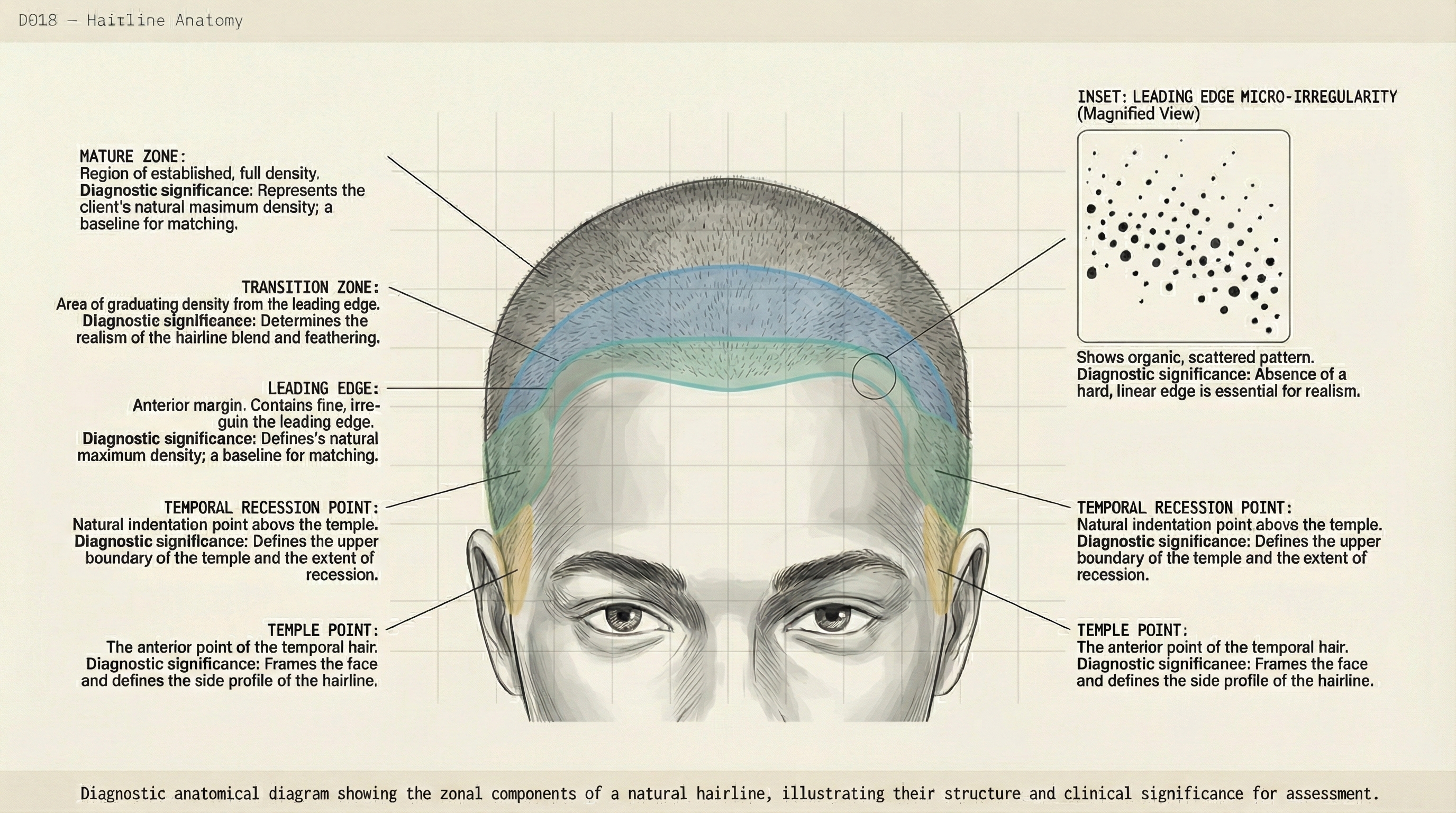
A natural hairline is not a single line. It is a transition zone with five distinct components that work together to create the perception of organic hair growth.
Component 1: The Leading Edge
The absolute front boundary of hair growth. In a natural hairline, this is not a straight line. It is an irregular, slightly wavy boundary where vellus hairs give way to terminal hairs. The leading edge has the lowest density — single-hair follicular units at wide, irregular spacing.
Component 2: The Transition Zone
Immediately behind the leading edge. Density increases progressively from sparse single-hair units to denser multi-hair units. Typically 10–20mm deep. The gradient must be continuous, not stepped.
Component 3: The Temple Points
Where the hairline meets the temporal recession. The temple points define the M-shape, widow's peak, or squared-off character. They sit on the temporal fossa — Module 1's most challenging skull zone.
Component 4: The Midpoint
The centre of the hairline. May be lowest (widow's peak), highest (mature recession), or level with temple corners (juvenile). The midpoint is the emotional anchor — where the client's eye goes first in the mirror.
Component 5: The Sideburn Transition
Where the hairline descends into the sideburn area. Must blend with facial hair pattern and tolerate the barber's regular cleanup work.
Ready to test your knowledge?
Complete the module quiz to track your progress. You need 80% to pass.
Start Quiz (10 questions)